
Last updated October 16, 2026
 Water damage drying
 Fire & smoke cleanup
 Mold remediation
 Storm response
 Sewage cleanup
 Reconstruction
Free visual inspection and a written scope of work before any mitigation begins - photos, moisture readings, and drying logs go in your claim file
The scope we write is the scope we bill. Anything new gets shown to you, in writing, before we touch it.
Get your free estimateDIY vs Professional Damage Restoration: The West Palm Beach Homeowner’s Decision Guide
Pulling up wet carpet yourself in the first hour after a pipe burst is genuinely helpful. Running a rented dehumidifier for four days without moisture readings is not drying your home. It is creating a false sense of completion while relative humidity inside your wall cavities stays above 60%, the threshold at which mold begins to colonize. This guide draws that line precisely for West Palm Beach homeowners, because Florida’s climate turns the DIY-versus-professional question into something more urgent than a budget debate. For more guides & resources, see our blog. You’ll learn exactly which tasks are safe to handle yourself, which ones quietly void insurance claims, and when the humidity outside makes waiting more expensive than calling.
Quick Answer
For clean water from a burst supply line, West Palm Beach homeowners can and should remove water and protect contents in the first hour, then call a professional for structural drying within 4 hours. For any sewage, toilet overflow, or outdoor flood water, DIY is not a cost-saving option; it is a health and legal liability. Professional restoration with calibrated drying equipment costs more upfront but protects your insurance claim, your drywall, and your family’s breathing air. If you’re unsure how to choose the right team, read our How to Hire a Damage Restoration Contractor in West Palm Beach: A Step-by-Step Guide.
Restoration work we handle
Table of Contents
- The First 60 Minutes: What You Should Do Yourself
- Where DIY Ends: Equipment, Readings, and the Science of Drying
- The Three DIY Actions That Complicate Insurance Claims
- Category 2 and 3 Water: When DIY Becomes a Health Risk
- Mold in West Palm Beach: The 24-48 Hour Window
- The Decision Tree: A Neighbor’s Honest Advice
- Fire and Smoke Damage: Why Open Windows Don’t Fix It
- Cost Real Talk: What DIY Saves and What It Costs
The First 60 Minutes: What You Should Do Yourself
There is a window right after water damage where a homeowner’s direct action genuinely changes the outcome. In West Palm Beach, where the outdoor air rarely drops below 70% relative humidity during summer, that window is shorter than in drier climates. Here is what you should do, in order, before you pick up the phone.
- Stop the water at the source. Shut off the supply valve at the fixture, or the main shutoff at the meter if you cannot find the fixture valve. This is the single most important action. Every minute of active flow adds water that must be extracted later.
- Kill the power to affected rooms. Water and electricity do not mix, and wet outlets are a shock hazard. Switch off the breaker for the affected area if you can reach the panel without standing in water.
- Remove surface water with towels or a wet-vac. A standard shop vac pulls standing water off tile, hardwood, and vinyl. This reduces the total moisture load and buys time. Do not use a standard household vacuum. It will short out and the dust in the bag becomes a wet, conductive mess.
- Move furniture and belongings to dry ground. Wood furniture legs wick water upward. Metal furniture leaves rust rings on carpet and wood. Aluminum foil under legs that cannot be moved prevents staining. Lift curtains and bedding off the floor. Move electronics and documents to a dry room.
- Photograph everything before you move it. Insurance adjusters look at photos first. Take wide shots of each affected room, then close-ups of water lines, wet drywall, and damaged contents. Document standing water depth if visible. These photos are your record of what happened before anything was disturbed.
These first-hour actions are the limit of genuinely useful homeowner mitigation. They reduce the volume of water and protect contents. They do not dry the structure. In our experience across West Palm Beach homes, from Flamingo Park to Ibis Golf and Country Club, the structural materials holding water are almost never visible from the surface: drywall wicks water up from the base, subflooring absorbs through seams, and wall cavities trap moisture behind baseboards.
This guide is part of the Tidemark Water Damage West Palm Beach home resource library, built to help homeowners make decisions before an emergency forces one.
Where DIY Ends: Equipment, Readings, and the Science of Drying
The assumption behind most DIY drying attempts is that removing visible water equals removing water. That assumption fails at the wall cavity. Structural drying requires reducing the moisture content of building materials to a specific target range, usually 8% to 12% for wood and under 4 on a moisture meter for drywall, and keeping it there long enough for the material to stabilize. Consumer equipment is not built for this job.
The GPP Difference: Consumer vs Professional Dehumidifiers
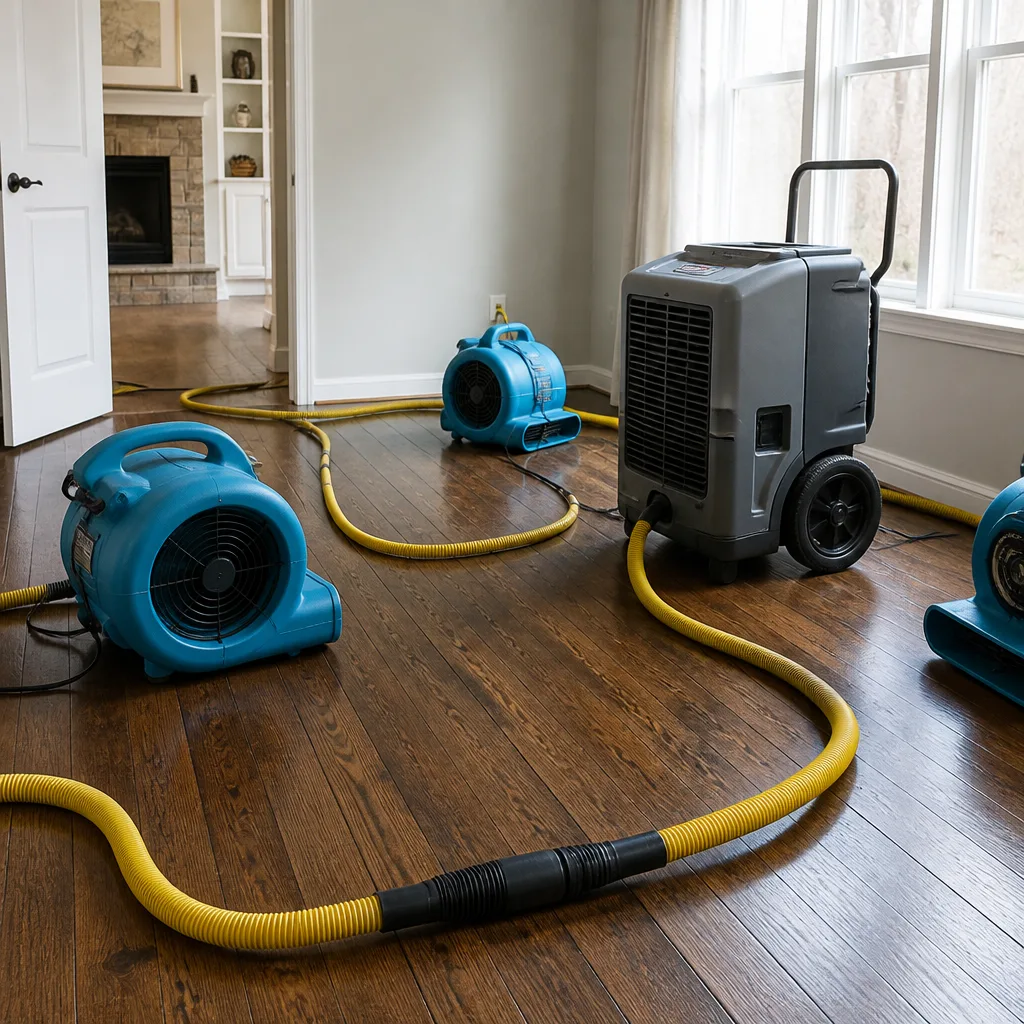
The meaningful spec on a dehumidifier is not its pint rating on the box. It is its GPP output, or grains per pound, which measures how much moisture the machine removes per pound of air processed. A $300 consumer dehumidifier rated at 50 pints per day typically operates at 50 to 65 GPP under AHAM conditions, which are 80°F and 60% relative humidity. A professional LGR (low grain refrigerant) dehumidifier like a Phoenix 200 or a Dri-Eaz LGR 7000XLi operates at 140 to 180 GPP in the same initial conditions, and crucially, it continues pulling meaningful moisture as the air gets drier, down below 30 grains. Consumer units essentially stop working when the air gets dry, which is exactly when the water trapped in drywall and subfloor needs the pressure differential to migrate outward.
What this means in a West Palm Beach home: a consumer dehumidifier running for four days in a water-damaged bedroom will bring the room’s ambient humidity down, so the air feels dry. The drywall behind the baseboard remains above 20% moisture content. The homeowner smells nothing, sees nothing, and assumes the job is done. Two weeks later, the baseboard pops loose and a dark stain appears. The mold question no longer works in their favor with the insurance company.
Professional Water Damage Restoration in West Palm Beach uses calibrated equipment and moisture meters to verify dryness, not guess it. The readings are documented in writing, which becomes part of your claim file.
The Three DIY Actions That Complicate Insurance Claims
Insurance is almost always in the room, even when nobody says it out loud. The policy language on water damage typically requires the homeowner to take reasonable steps to mitigate further damage. That part favors action. But three specific DIY actions create documented evidence that can shift liability, reduce a settlement, or void a claim entirely.
- Running fans before documenting the damage. Fans push water vapor into the air and spread it through the house. If the initial damage photos are missing, and the adjuster then sees water staining in rooms that were not affected in the original claim, the insurer can reasonably question whether the homeowner’s actions spread the damage. Document first, then dry.
- Removing building materials before moisture mapping. Tearing out wet drywall or pulling up carpet without a moisture map means the adjuster cannot verify the scope of the water travel. The homeowner is then asking the insurer to pay for work that cannot be proven necessary. A moisture map, created with a moisture meter and thermal imaging, establishes the tide mark, the line water leaves as it wicks through materials. Without it, the claim relies on the homeowner’s word about how far the water went.
- Applying bleach to potential mold without pre-testing. Bleach on a porous surface like drywall does not kill mold at the root. It bleaches the surface, making the colony temporarily invisible while the mycelium survives underneath. When the mold reappears, the insurer sees evidence that the homeowner attempted remediation and failed, which can be read as improper handling of a covered loss. Pre-testing with a certified mold assessor establishes the species and scope before any treatment.
None of these actions are malicious. They are understandable instincts, documented widely in online forums and generic advice columns. But Florida insurers process thousands of water claims annually, and these three patterns are well known to adjusters. The homeowner who photographs first, resists demolition, and avoids chemical treatment keeps the claim file clean and the burden of proof on their side.
Category 2 and 3 Water: When DIY Becomes a Health Risk
The IICRC S500 standard classifies water damage into three categories. Category 1 is clean water from a supply line or faucet. Category 2 is significantly contaminated water that can cause discomfort or sickness if contacted or consumed, such as washing machine overflow, dishwasher discharge, or toilet overflow with urine only. Category 3 is grossly contaminated water containing pathogenic, toxigenic, or other harmful agents: sewage backup, toilet overflow with feces, flood water from outside, or standing water that has begun to support microbial growth.
For Category 2 and Category 3 water, DIY is not a cost-saving option. It is a health and legal liability. Here is why, specific to West Palm Beach:
- Pathogenic exposure is real. Sewage contains E. coli, Salmonella, Hepatitis A, and a host of other organisms. Cleaning without PPE, including gloves, respirator, and full-body protection, exposes the homeowner to infection. The cleanup water and materials then become hazardous waste that requires proper disposal.
- Legal liability attaches to improper disposal. Florida law regulates the disposal of sewage-contaminated materials. Hauling wet sewage carpet to the curb in standard trash bags violates local waste codes and creates a public health hazard for neighbors and sanitation workers.
- West Palm Beach’s water table and drainage characteristics mean outdoor flood water is always Category 3. Street flooding after a heavy rain carries fertilizer runoff, animal waste, automotive fluids, and whatever else drains off the asphalt. After Hurricane Ian passed through, we saw flood water in West Palm Beach neighborhoods that tested positive for bacterial contamination within hours. This is not water you mop up with towels.
- Insurance policies treat Category 3 differently. Sewage backup may require a specific rider or endorsement. If the homeowner begins removing sewage-contaminated materials without documentation, the adjuster has no way to verify what was disposed of or why. The claim gets harder, not easier.
The professional protocol for Category 3 water involves containment barriers, HEPA air filtration, antimicrobial application, and controlled demolition with proper disposal tracking. The IICRC-trained technicians at Mold Remediation in West Palm Beach handle this as a standard process, with photo documentation at every stage.
Mold in West Palm Beach: The 24-48 Hour Window
The rule of thumb in dry climates is that mold needs 48 to 72 hours to colonize after water exposure. In West Palm Beach, that window narrows. Our outdoor relative humidity sits above 70% for most of the year, and indoor relative humidity in an unmitigated water loss quickly matches it. Mold spores, which are always present in South Florida air, find these conditions ideal. Colonization on wet drywall can begin within 24 hours. Visible growth appears by day three or four.
This is the timeline that makes professional response urgent, not optional, for anything beyond a small spill. A homeowner who dries a spill with towels and leaves a fan running overnight has handled the situation appropriately. A homeowner who comes home to a burst supply line that had been running for four hours while they were at work is dealing with water that has already soaked into drywall, baseboards, subfloor, and possibly wall cavities. That water will not evaporate fast enough to beat the mold clock in West Palm Beach humidity, no matter how many box fans are pointed at it.
Consumer Dryers and the Humidity Ceiling
Fans do not remove moisture. They move air, which evaporates surface water into the room air. Without a dehumidifier capturing that moisture, it simply recondenses on cooler surfaces and inside wall cavities. A consumer dehumidifier, as explained above, stops meaningfully pulling water when the air reaches roughly 40% to 50% relative humidity. The moisture inside the drywall remains locked in the material because the pressure differential is not strong enough to pull it out. The wall feels dry to the touch. The moisture meter says otherwise.
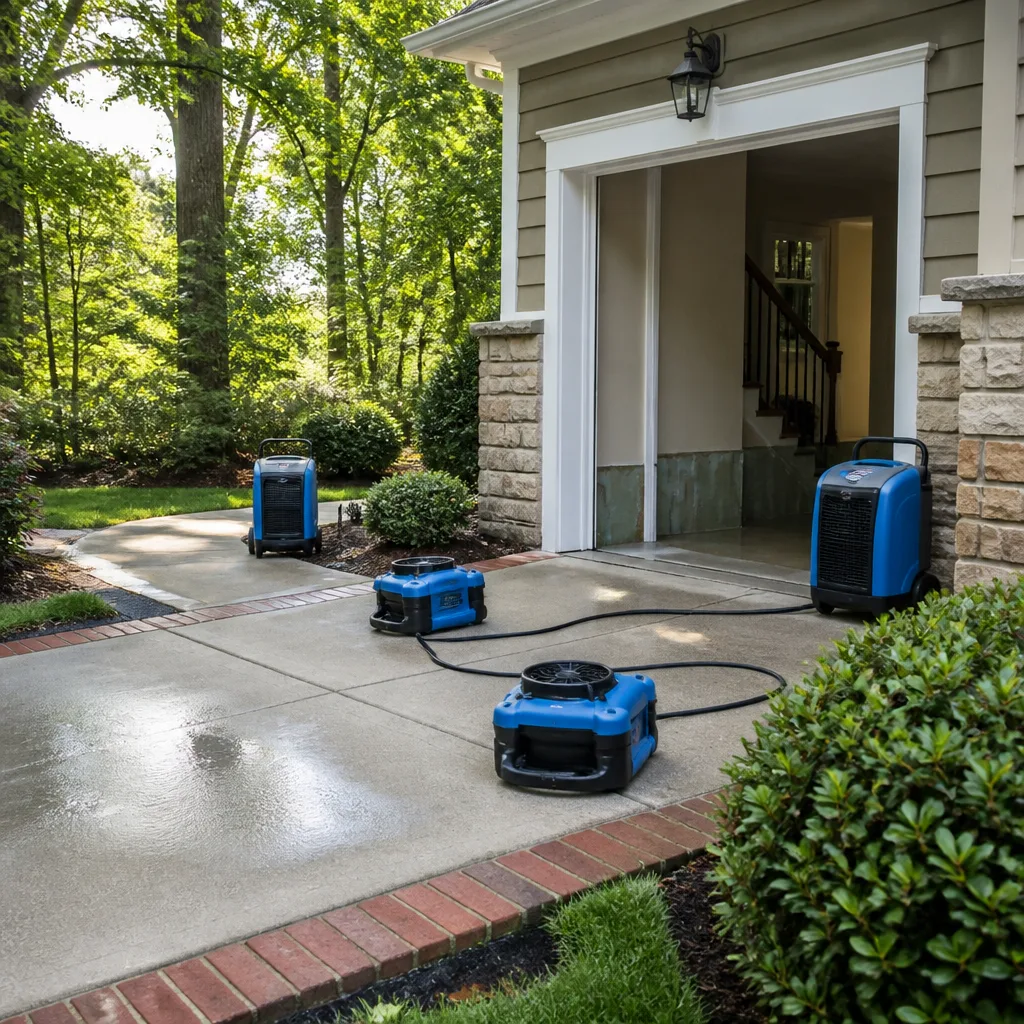
The professional equipment used by West Palm Beach restoration crews includes LGR dehumidifiers from Dri-Eaz and Phoenix, which continue extracting water down to 20 grains per pound, paired with high-volume air movers from XPOWER that create the evaporation necessary for the dehumidifier to work. It is not the equipment alone that matters. It is the combination, sized correctly for the cubic footage of the affected space, monitored daily with moisture readings.
The Decision Tree: A Neighbor’s Honest Advice
If you are standing in a wet room right now, this is the decision tree we would walk through if you were our neighbor. No sales language. Just the honest breakpoints.
Conditions where you should begin mitigation yourself, then call within 4 hours:
- The water is clean, from a supply line, faucet, or appliance hose.
- The affected area is under roughly 100 square feet.
- The water has been sitting for under 2 hours.
- No water has touched drywall, baseboards, or flooring seams.
- You have photos of the damage before moving anything.
In these conditions, do the first-hour tasks described above. Then call a professional for a moisture assessment. The small cost of an assessment protects you from the much larger cost of concealed mold.
Conditions where professional response is non-negotiable, and you should call immediately:
- The water is Category 2 or Category 3 (sewage, toilet overflow with feces, outdoor flood water, or contaminated appliance discharge).
- Water has contacted drywall, especially if the water line is above the baseboard.
- The affected area is over 100 square feet or spans multiple rooms.
- The water has been sitting for more than 2 hours.
- You can already smell an earthy or musty odor.
- Any occupant has asthma, allergies, immune compromise, or is a young child or elderly.
- The water came from a source you cannot identify or stop.
This second list is not a sales threshold. It is the line where the physical timeline of moisture damage in West Palm Beach’s climate outruns what a homeowner can safely or effectively handle. Waiting on this side of the line does not save money. It converts a drying job into a demolition job.
Fire and Smoke Damage: Why Open Windows Don’t Fix It
Fire damage restoration gets less attention than water damage in DIY discussions, but the same logic applies with sharper edges. Smoke is not a smell. It is a suspension of microscopic particles, including carbon, acids, and VOCs, that penetrates porous surfaces and lodges in place. Opening windows ventilates the room air. It does not remove the particles embedded in drywall, carpet, upholstery, or the underside of the ceiling.
The chemical timeline matters. Within days of a fire, soot residue begins to etch painted surfaces and corrode metal fixtures. The longer it sits, the more permanent the damage becomes. A homeowner who waits a week while airing out the house is not saving restoration costs. They are adding a repaint and a fixture replacement to the claim.
Fire damage restoration involves specialized processes: dry sponge cleaning for soot removal from ceilings and walls, ozone or hydroxyl treatment for odor, and controlled demolition of charred or water-damaged materials from firefighting. None of these processes are available at a hardware store. For West Palm Beach homeowners, the fire restoration process from Fire Damage Restoration in West Palm Beach includes insurance documentation support because fire claims require precise inventorying and scope documentation that differs significantly from water claims.
Cost Real Talk: What DIY Saves and What It Costs
Let us put dollar figures on this, because the DIY conversation usually starts with the receipt from the rental counter. A hardware store dehumidifier rental runs $75 to $125 per day. A 3-day rental plus a shop vac purchase lands around $400 to $500. A professional drying setup for a single room in a West Palm Beach home typically runs $1,200 to $2,500 depending on the room size, the materials affected, and the number of air movers and dehumidifiers required. The professional job includes moisture mapping, daily readings, equipment monitoring, and a written drying certificate at the end.
That difference is the number homeowners see. What they do not see on the front end is the cost of the DIY attempt when it under-dries the structure. Mold remediation in a single wall cavity in West Palm Beach starts around $1,800 to $3,500 once the drywall is opened, the cavity is treated, and the space is rebuilt. If the mold is discovered by an insurance adjuster who notes that the homeowner’s drying attempt was insufficient, the remediation cost may fall on the homeowner, not the policy.
The math changes when you add the insurance variable. Professional restoration companies document everything and submit directly to your insurer. The homeowner’s out-of-pocket is often limited to their deductible. The DIY route means the homeowner carries the full cost of whatever the rental equipment fails to fix. In West Palm Beach’s climate, where the failure rate of consumer drying is highest in the continental United States, the bet is not a good one.
Common Mistakes to Avoid
- Waiting until morning because it is late. Water does not sleep, and in West Palm Beach humidity, the 24-hour mold clock starts at the moment of the incident, not at 9 AM the next day. Every hour of delay in a Category 2 or 3 loss expands the remediation zone and the cost.
- Cutting open drywall to inspect for water. Homeowners who open walls without containment barriers release any mold spores that have already begun colonizing inside the cavity. The inspection then contaminates the room, and the insurer may view the action as worsening the loss. Leave the exploratory demolition to professionals with negative air setups.
- Trusting the “dry to the touch” test. Drywall can feel dry on the face while holding 25% moisture content at the base. A moisture meter costs under $40 and gives you a number instead of a guess, but understanding what that number means for the full structure is the professional’s job.
- Using a household dehumidifier as the primary drying tool. A consumer unit running continuously for a week in a water-damaged room still cannot pull moisture out of wall cavities. It adjusts room comfort. It does not dry structure.
- Assuming insurance covers mold because it covers water. Florida policies vary widely and many exclude mold or cap it at a specific dollar amount. Calling your agent early, and documenting the initial loss thoroughly, is the single best insurance-protection move a West Palm Beach homeowner can make.
- Renting a carpet cleaner and shampooing after water damage. Shampooing a water-damaged carpet adds soap residue to the fibers, which is itself a nutrient source for mold. Extraction and drying come first. Cleaning comes after the carpet is dry or it does not come at all.
- Filing the claim after starting demolition. The adjuster needs to see the damage as it was. Once materials are bagged and gone, that evidence is gone too. Call the insurer first, get the claim number, and let the restoration process begin with documentation in place.
See the difference
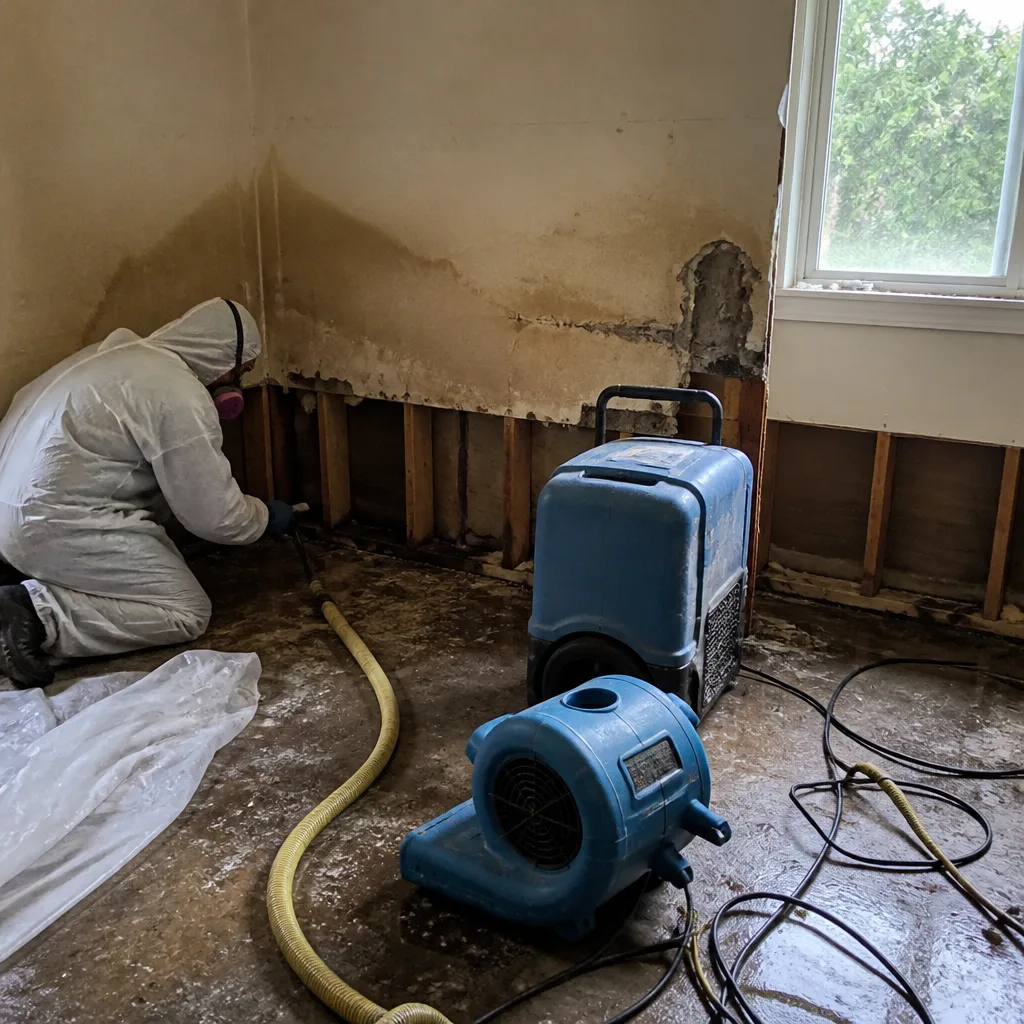 Before
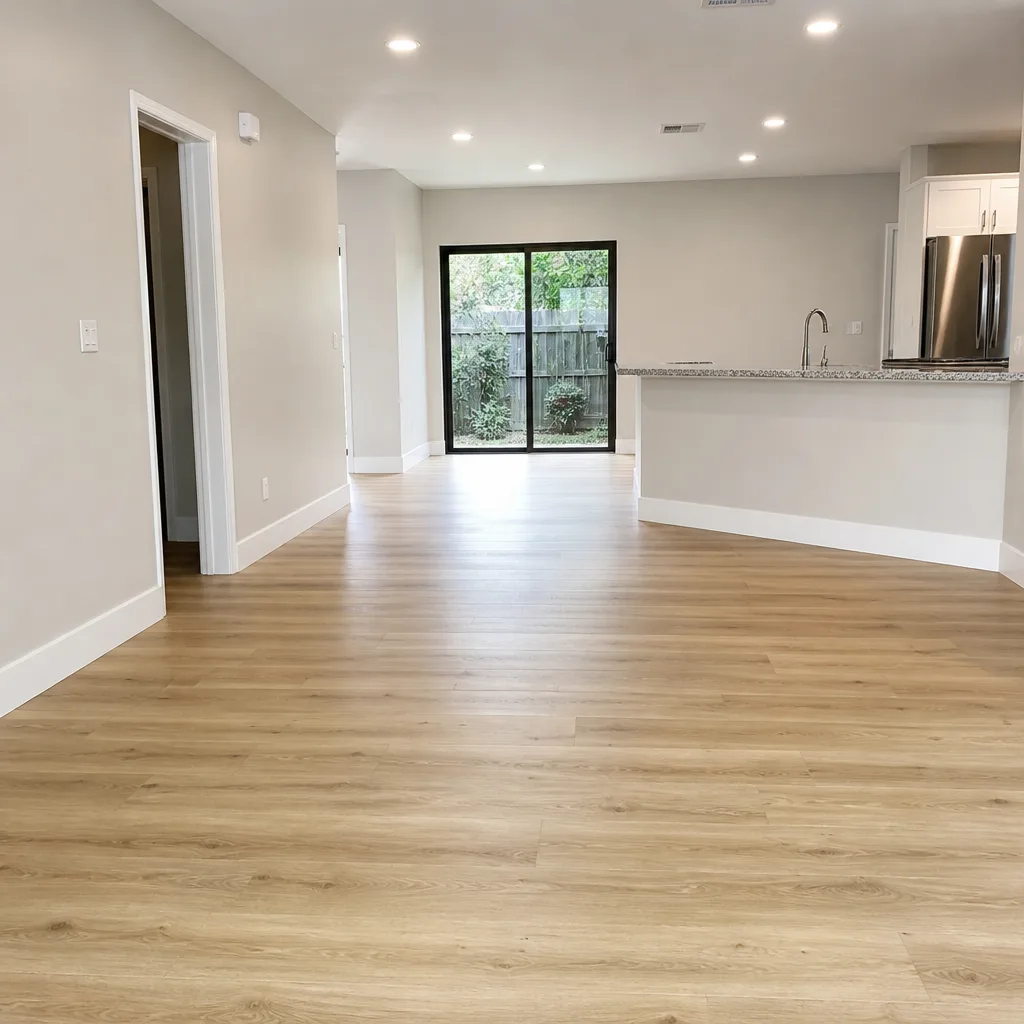 After
After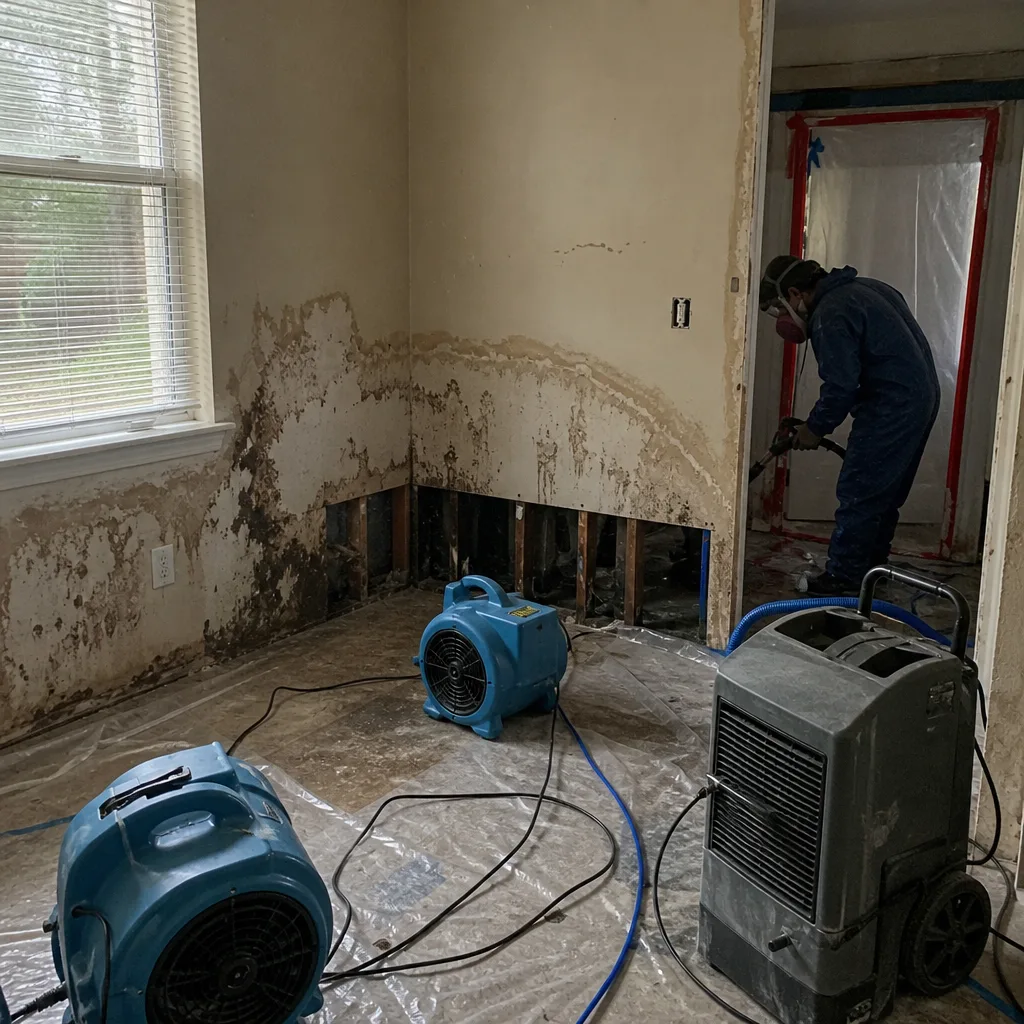 Before
 After
After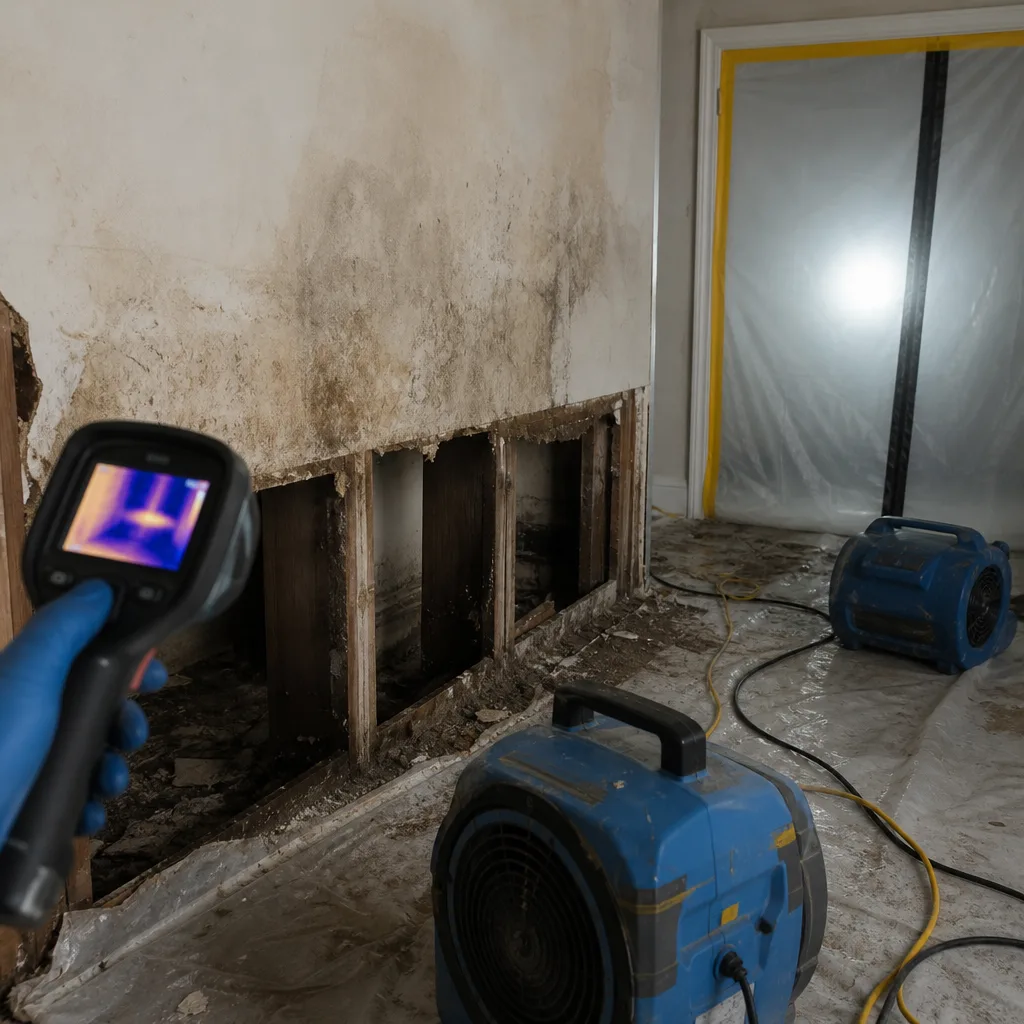 Before
 After
AfterWhen to Call a Professional
Call a professional the moment any of these apply: the water is contaminated, the affected area is larger than a single room, water has touched drywall, the damage has been sitting for more than two hours, anyone in the home has respiratory concerns, or you simply do not want to gamble a $400 rental setup against a $4,000 mold remediation. Tidemark Water Damage West Palm Beach offers free estimates in West Palm Beach, and every assessment includes a written scope and a written price before any work starts. The call is answered by a person, not a queue, at any hour, because water does not wait for business hours.
Frequently Asked Questions
You can handle the first hour: stop the water, remove surface water, move furniture, and photograph everything. But structural drying in West Palm Beach’s humidity requires professional LGR dehumidifiers and moisture meters, because the outdoor air is too wet for passive drying to work. Call a professional within 4 hours for a moisture assessment.
Mold colonization can begin within 24 hours on wet drywall in West Palm Beach due to the consistently high outdoor relative humidity. Visible growth typically appears within 3 to 4 days. The 48-to-72-hour rule used elsewhere fails to account for South Florida’s year-round moisture load.
Insurance covers reasonable mitigation, which includes your documented first-hour actions like water removal and content movement. It does not cover structural damage caused by inadequate drying. If a DIY drying attempt leaves walls wet and mold follows, the insurer may determine that the mold was caused by improper mitigation, not the original water event, and deny the mold claim.
The difference is GPP output and low-humidity performance. A consumer unit pulls 50 to 65 GPP and stops working effectively below 50% relative humidity. A professional LGR unit pulls 140 to 180 GPP and continues extracting moisture down to 20 grains per pound, which is required to pull water out of drywall and subflooring.
Shut off the water at the nearest valve or the main shutoff. Kill power to the affected area. Remove standing water with towels or a wet-vac. Move furniture and belongings to dry ground. Photograph everything before you move it. Then call a professional restoration company for a moisture assessment, because the hard surface of the floor is not the problem; the wall cavities behind the baseboards are.
Water damage calls are answered live 24/7 by restoration companies that serve West Palm Beach, and a crew can typically arrive within 60 to 90 minutes of the call. The assessment includes moisture mapping, a written scope, and a written price before any work begins. The first-hour work you do yourself, documented well, improves the outcome regardless of who handles the structural drying.
The Bottom Line
The DIY-versus-professional water damage question in West Palm Beach is not a cost decision. It is a liability and timeline decision. The first hour belongs to you: shut off the source, remove water, move contents, photograph everything. The hour after that belongs to a professional with LGR dehumidifiers, moisture meters, and the written documentation your insurance claim depends on. In a climate where mold colonizes within 24 hours and consumer dehumidifiers cannot pull moisture from wall cavities, the homeowner who acts decisively and then calls for backup is not spending more. They are spending less, because they are preventing the remediation that follows improper drying. West Palm Beach’s humidity does not give second chances on water damage, and our recommendation reflects that reality: document, mitigate the surface, and call the people with the equipment and the paperwork to finish the job correctly.
Written by Rick Sumner, Owner at Tidemark Water Damage West Palm Beach, serving West Palm Beach since 2006.